Srinivasa Ramanujan: The Letter That Changed Mathematics
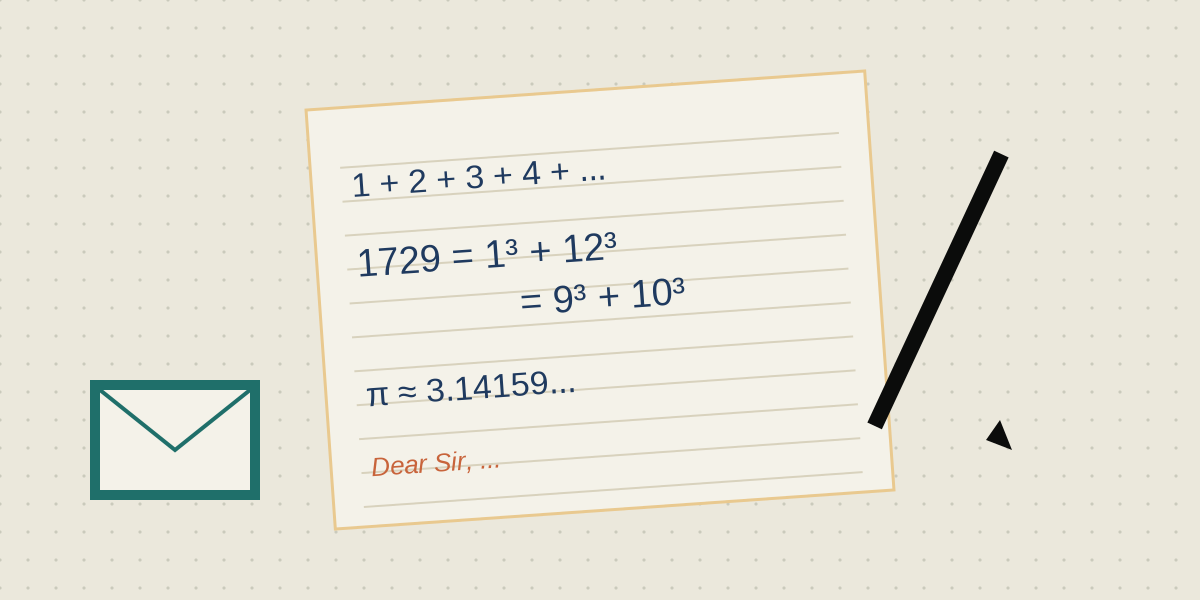
In January 1913, a Cambridge mathematician opened an envelope from India. Inside were pages of formulas so strange and so striking that he could not stop thinking about them. They had been written by a twenty-five-year-old clerk named Srinivasa Ramanujan.
This story is based on well-documented historical accounts. It is told in our own words; where dates or details are uncertain, we say so.
A boy and a borrowed book
Srinivasa Ramanujan was born on 22 December 1887 in Erode, in present-day Tamil Nadu, and grew up in the temple town of Kumbakonam. His family was not wealthy. His father worked as a clerk in a sari shop, and his mother sang at the local temple. From an early age, Ramanujan was fascinated by numbers in a way that puzzled the people around him.
As a teenager, he came across a book that would shape his life: a large collection of mathematical results compiled for students, commonly known as Carr's Synopsis. It listed thousands of formulas and theorems with very brief proofs, or none at all. For most readers it would have been a dry reference book. For Ramanujan, it was a door. He worked through it on his own, filling notebooks with results, and then went far beyond it.
Brilliant, and failing
Ramanujan's single-minded love of mathematics came at a cost. He won a scholarship to the Government College in Kumbakonam, but he was so absorbed in mathematics that he neglected other subjects and lost it. A later attempt at college in Madras also ended without a degree. For several years, he lived in poverty, tutoring students, searching for work and continuing to fill his notebooks.
It is worth pausing on this part of the story. By the usual measures of school and college, Ramanujan was a failure. He had no degree. His examination record was poor. Yet in his notebooks he was producing results that some of the best mathematicians in the world would later spend decades studying.
Eventually, with the help of supporters who recognised his talent, he found a job as a clerk at the Madras Port Trust in 1912. It gave him a small salary and, importantly, some time to continue his work.
The letter
Encouraged by friends, Ramanujan began writing to mathematicians in England. In January 1913, he wrote to G. H. Hardy, a leading mathematician at Trinity College, Cambridge. The letter introduced himself modestly as a clerk with no university education and enclosed several pages of theorems, without proofs.
Hardy later described his reaction in a way that has become famous among mathematicians. Some of the results he recognised. Some he could prove with effort. Others seemed so unusual that he could hardly believe them. He concluded that they must be true, because nobody would have had the imagination to invent them otherwise. He and his colleague J. E. Littlewood studied the pages and agreed: this was the work of an extraordinary mind.
The journey to Cambridge
Hardy invited Ramanujan to Cambridge. The decision was not simple. Crossing the sea raised religious and social concerns for his family, and Ramanujan hesitated. After much deliberation, and with arrangements for funding, he sailed for England in 1914.
Life in Cambridge was difficult in many ways. The weather was cold and grey. As a strict vegetarian, he struggled to find suitable food, especially once the First World War began and supplies became scarce. He was far from his family. Yet the years that followed were some of the most productive in the history of mathematics.

An unusual partnership
Hardy and Ramanujan were very different people. Hardy was a rigorous, sceptical Englishman who insisted on careful proof. Ramanujan worked by intuition, often arriving at results without being able to say exactly how. Their partnership worked because each respected what the other brought. Hardy helped Ramanujan learn the language of formal proof; Ramanujan showed Hardy ideas he would never have reached on his own.
Together, they produced important work, including on the partition of numbers: the question of how many different ways a whole number can be written as a sum of smaller whole numbers. Ramanujan also made remarkable contributions to infinite series, continued fractions and number theory.
In 1916, Ramanujan received a degree from Cambridge for his research. In 1918, he was elected a Fellow of the Royal Society, one of the highest honours in science, and in the same year became a Fellow of Trinity College. He was among the first Indians to receive these honours.
The taxi-cab number
One of the best-loved stories about Ramanujan comes from Hardy. During one of Ramanujan's illnesses, Hardy visited him and remarked that he had arrived in a taxi with the rather dull number 1729. Ramanujan is said to have replied immediately that it was not dull at all: it is the smallest number that can be written as the sum of two cubes in two different ways (1³ + 12³ and 9³ + 10³). Since then, 1729 has been known among mathematicians as the Hardy-Ramanujan number.
The story is often told to show Ramanujan's extraordinary familiarity with numbers. To him, numbers were not abstract symbols. They were, in a sense, old friends.
Return and a short life
Ramanujan's health declined during his years in England. He returned to India in 1919 and continued working even as he grew weaker. He died on 26 April 1920, at the age of just 32.
His notebooks, however, lived on. Mathematicians have spent decades proving and understanding the results in them. A collection of his later work, often called the "lost notebook", was rediscovered in 1976 and has inspired further research. Ideas that began in his notebooks have found connections in many areas of modern mathematics and science.
Remembering Ramanujan
In India, 22 December, Ramanujan's birthday, is celebrated as National Mathematics Day. Schools and colleges mark it with quizzes, talks and activities that encourage students to see mathematics as something creative and exciting.
Why his story still feels modern
More than a hundred years later, Ramanujan's story still resonates with students. Many young people today are passionate about a subject that their school results do not reflect. Some teach themselves through books, videos and online courses. Some feel isolated because nobody around them shares their interest. His life is a reminder that talent can appear anywhere, and that reaching out, as he did with his letters, can open doors that seemed firmly closed.
What students can learn from his story
- Curiosity is powerful. Ramanujan's progress began with a single book and an intense desire to understand.
- Exams do not measure everything. His poor academic record hid a rare talent. A setback in school is not the end of the road.
- Mentors and supporters matter. Friends in India, and later Hardy, helped him find opportunities he could not have reached alone.
- Different strengths complement each other. Intuition and rigour together achieved more than either could alone.
- Share your work. One brave letter changed his life.
If you are studying mathematics, you may enjoy our guide to the Class 10 maths syllabus, and you can explore more stories in our history section.
Sources
Facts, figures and quoted rules in this article come from the sources below. The wording of the article is our own.
- The Man Who Knew Infinity: A Life of the Genius Ramanujan-Robert Kanigel, Charles Scribner's Sons, 1991
- Ramanujan: Twelve Lectures on Subjects Suggested by His Life and Work-G. H. Hardy, Cambridge University Press, 1940
- The Short Life of Srinivasa Ramanujan, MacTutor History of Mathematics Archive, University of St Andrews
- Srinivasa Ramanujan, FRS, Trinity College, Cambridge
Frequently asked questions
When is National Mathematics Day?
National Mathematics Day is celebrated in India on 22 December, Ramanujan's birthday.
What is the Hardy-Ramanujan number?
1729, the smallest number that can be written as the sum of two cubes in two different ways: 1³ + 12³ and 9³ + 10³.