Conference, Summit, Trade Show or Workshop? Event Formats Explained
Event names are used so loosely that they have almost lost their meaning. One organiser calls a two-hour talk a summit; another calls a three-day international gathering a meet. If you are deciding which events to attend, or which kind of event to organise, it helps to know what each format is actually designed to do.
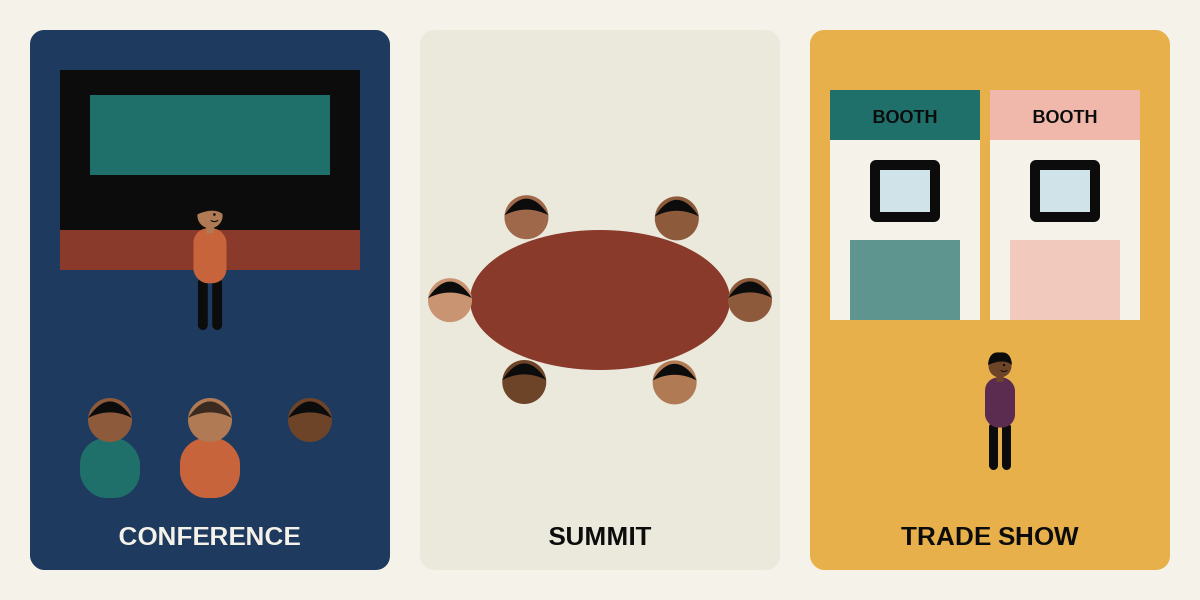
Why the format matters
Every event format makes a trade-off between reach and depth. A large exhibition can reach tens of thousands of people, but conversations are short. A small workshop reaches a handful of people, but they leave with real skills. Neither is better; they do different jobs. Choosing the wrong format is one of the most common reasons events disappoint.
Conference
A conference is a gathering, usually over one to several days, where people from a field or industry come together to hear talks, presentations and panel discussions. Many conferences also include smaller breakout sessions and an exhibition area.
Best for: sharing knowledge, research and ideas with a large audience; seeing where an industry is heading.
Watch out for: programmes so packed with talks that there is no time to digest anything.
Summit
Strictly speaking, a summit is a meeting of leaders: heads of government, chief executives or senior figures who come together to discuss and sometimes decide on shared issues. In business, the word is often used for high-level conferences with senior speakers and invited audiences.
Best for: discussions among decision-makers on strategic questions.
Watch out for: the word being used for ordinary events to sound more important.
Trade show, trade fair or expo
A trade show is an exhibition where companies display products and services in stalls or pavilions. Visitors walk the halls, compare offerings and talk to exhibitors. Many have dedicated business days and public days. Read our visitor's guide to trade fairs for practical tips.
Best for: finding suppliers, comparing products, launching new products and meeting distributors.
Watch out for: visiting without a plan and leaving with a bag of brochures and nothing else.
Seminar
A seminar is a smaller, more focused session, usually led by one or two experts, on a specific topic. It is more interactive than a conference talk, with time for questions and discussion. In universities, seminars are small teaching groups that discuss readings.
Best for: learning about a specific topic in depth, with the chance to ask questions.
Workshop
A workshop is hands-on. Participants actively do something: solve problems, practise a skill, build a prototype or create a plan. The facilitator guides rather than lectures.
Best for: building practical skills and producing tangible outcomes.
Watch out for: "workshops" that are really lectures with a few questions at the end.
Roundtable
A roundtable brings together a small group of peers, usually ten to fifteen, to discuss one question as equals with a moderator. There is no audience. Our guide to what a roundtable is and how to host one covers it in detail.
Best for: honest, in-depth discussion among experienced people.
Symposium
A symposium is a formal meeting, often academic, where experts present papers or views on a particular subject and then discuss them. It is common in universities and research institutions.
Best for: presenting and debating research.
Webinar and virtual event
A webinar is an online seminar or presentation. Virtual events can range from a single webinar to multi-day online conferences with chat rooms and virtual booths.
Best for: reaching people across cities and countries at low cost, and recording content for later.
Watch out for: screen fatigue. Online sessions should be shorter and more interactive than in-person ones.
Festival
A festival is a celebration, usually public, built around culture, art, music, film, literature, food or tradition. Festivals often run over several days and across multiple venues. Read why cultural festivals matter.
Best for: cultural experience, community building and tourism.
Hackathon
A hackathon is an intensive event, often over a day or a weekend, in which teams build software, products or solutions to a challenge. Originally a technology format, it is now used in design, healthcare, education and social innovation too.
Best for: rapid prototyping, recruiting talent and encouraging creative problem-solving.
A quick comparison
| Format | Typical size | Main purpose | Interaction |
|---|---|---|---|
| Conference | Hundreds to thousands | Sharing knowledge | Low to medium |
| Summit | Dozens to hundreds | Leadership discussion | Medium |
| Trade show | Thousands | Products and business | Short conversations |
| Seminar | 10-100 | Focused learning | Medium |
| Workshop | 5-40 | Practical skills | High |
| Roundtable | 8-20 | Peer discussion | Very high |
| Webinar | Any | Remote learning | Low to medium |
| Festival | Hundreds to millions | Culture and celebration | Varies |
How to choose the right format
If you are an attendee, ask yourself what you want to leave with. Information? Go to a conference. Skills? Choose a workshop. Contacts in your industry? A trade show or roundtable. Inspiration? A festival.
If you are an organiser, start with the outcome you want and the number of people you need to reach. Then choose the smallest format that achieves it. Smaller events are easier to run well, and they are usually remembered more fondly than large ones that felt impersonal.
Many successful events combine formats: a conference with workshops in the afternoon, or a trade show with a seminar stage. Mixing works well, as long as each part has a clear purpose.
Meet-ups, masterclasses and bootcamps
A few other names come up often enough to deserve a quick explanation.
A meet-up is an informal, usually free gathering of people who share an interest, such as a programming language, a type of photography or a running route. It is often organised by volunteers and held in a cafe, a co-working space or a company office after work. Meet-ups are low pressure, which makes them a good first step for students and people new to a city.
A masterclass is a session led by someone with deep, recognised expertise, often in front of a small group. The value lies in watching an expert work and receiving direct feedback. In music and the arts, a masterclass may involve one participant performing while the expert coaches them in front of others.
A bootcamp is an intensive training programme that runs over several days or weeks, built to take people from beginner to job-ready in a specific skill. Bootcamps are common in coding, data and design. They demand serious time and often money, so it is worth checking what past participants actually went on to do.
An award ceremony or gala recognises achievement within a field. These evenings are mainly about celebration and visibility. They can be worthwhile for building relationships, but they rarely teach you much, so it helps to be honest with yourself about why you are going.
What the format tells you about the ticket price
Format also explains why prices vary so much. Large conferences and trade shows spread their costs across thousands of visitors and exhibitors, so day passes can be modest, while exhibitor stalls are expensive. Workshops and masterclasses have small groups and a skilled facilitator for every few participants, so they cost more per person but deliver more personal attention. Summits for senior leaders are often invitation-only, with costs covered by sponsors. Knowing this helps you judge whether a price is fair for what you will actually receive.
Final word
Names will always be used loosely. What matters is what happens in the room. Before you register for an event or plan one, look past the label and ask: who will be there, what will they do, and what will they take away?
Browse conferences and summits, workshops and all events on Breitordo.
Sources
This is an original article written by the Breitordo Editorial Team from general knowledge and practical experience. It does not quote, copy or reproduce material from other publications.
Frequently asked questions
What is the difference between a conference and a seminar?
A conference is a large gathering with many talks over one or more days. A seminar is a smaller, focused session on one topic with more interaction.
What is the difference between a summit and a conference?
A summit is, strictly, a meeting of leaders and decision-makers. A conference is broader and open to a wider professional audience.
What is a trade show?
An exhibition where companies display products and services to buyers, partners and visitors.