Science & Technology History
The History of Artificial Intelligence: From Early Computing to Generative AI and AI Agents
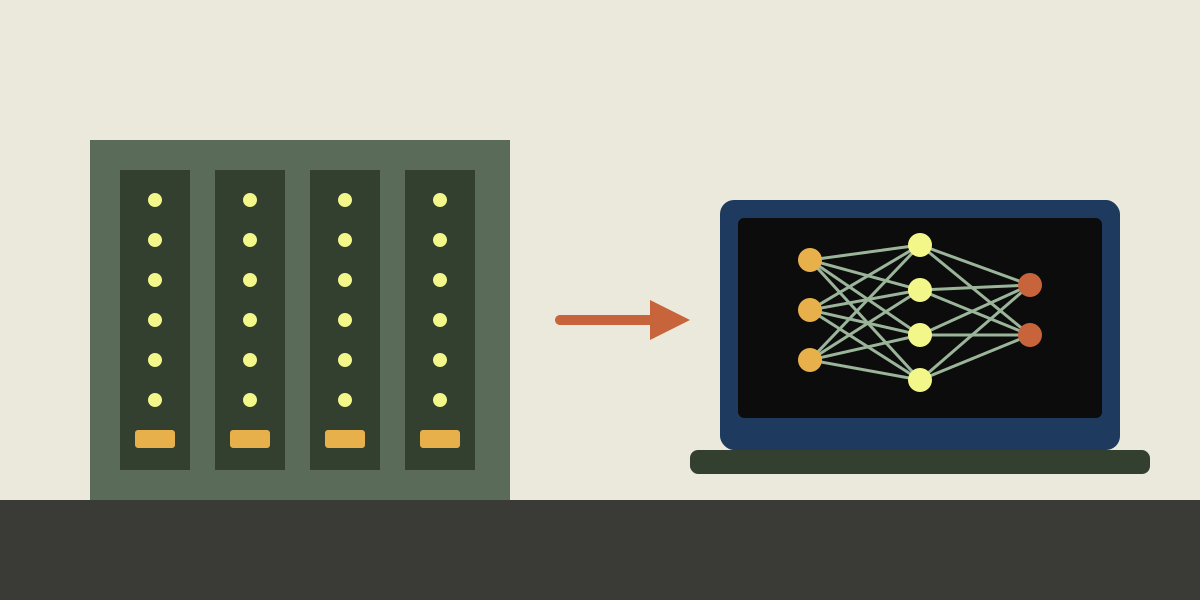
Artificial intelligence (AI) is the field of computer science that builds systems able to perform tasks usually associated with human intelligence, such as reasoning, recognising patterns, understanding language and making decisions. Its modern history begins with the first programmable computers of the 1940s and Alan Turing's 1950 paper on machine intelligence. The term "artificial intelligence" was introduced in the proposal for the 1956 Dartmouth summer workshop. The field then moved through periods of optimism and "AI winters": symbolic, rule-based AI and expert systems; statistical machine learning; deep learning from the 2010s; and, after the transformer architecture of 2017, large language models, generative AI and AI agents. Since the late 2010s, governments and international bodies have also developed principles and laws to govern AI.
Quick facts
- Field
- Computer science, drawing on mathematics, statistics, linguistics, psychology and neuroscience
- Term coined
- 1955 proposal for the 1956 Dartmouth Summer Research Project on Artificial Intelligence
- Key early paper
- Alan Turing, "Computing Machinery and Intelligence", Mind, 1950
- Main approaches
- Symbolic AI, machine learning, neural networks and deep learning
- Turning point
- "Attention Is All You Need" (2017) introduced the transformer architecture
- Governance milestones
- OECD AI Principles (2019), UNESCO Recommendation on the Ethics of AI (2021), EU AI Act (2024)
Introduction
Today, many people meet artificial intelligence through a chatbot, a translation app or a photo editor. It can feel as if AI arrived all at once. In fact, the idea of machines that think is centuries old, and the scientific field of AI is more than seventy years old. Its history is a story of big ambitions, long periods of disappointment and a few breakthroughs that changed everything.
This chapter follows that history step by step. To keep things clear, we separate what happened (the facts) from how historians and researchers interpret it. Interpretive passages are marked as such.
Before computers: ideas about thinking machines
Myths and stories in many cultures imagined artificial beings, and philosophers long debated whether reasoning could be reduced to rules. In the seventeenth century, Gottfried Wilhelm Leibniz imagined a universal language of reasoning in which arguments could be settled by calculation. In the nineteenth century, Charles Babbage designed the Analytical Engine, a mechanical general-purpose computer that was never completed, and Ada Lovelace wrote notes on it that are often described as containing the first published computer program. In 1854 George Boole published his work on the laws of thought, showing that logic could be expressed as algebra.
These ideas did not create AI, but they made a key assumption thinkable: that some forms of reasoning could be written down precisely enough for a machine to carry out.
Alan Turing and the first computers (1936-1950)
In 1936 the British mathematician Alan Turing described an abstract "universal machine" that could carry out any calculation that can be written as a step-by-step procedure. During and after the Second World War, the first electronic programmable computers were built in Britain and the United States. In 1943 Warren McCulloch and Walter Pitts published a mathematical model of a simplified neuron, an early ancestor of today's neural networks.
In 1950 Turing published "Computing Machinery and Intelligence" in the journal Mind. Instead of asking the vague question "Can machines think?", he proposed an "imitation game": could a machine hold a written conversation so well that a human judge could not reliably tell it apart from a person? This became known as the Turing Test.
Interpretation: historians generally see Turing's paper as the moment machine intelligence became a serious scientific question. Many researchers today regard the Turing Test as historically important but not a sufficient measure of intelligence.
Dartmouth 1956: the field gets its name
In 1955 John McCarthy, Marvin Minsky, Nathaniel Rochester and Claude Shannon wrote a proposal for a summer research project at Dartmouth College in the United States. It used the phrase "artificial intelligence" and stated the working assumption that every aspect of learning or intelligence could, in principle, be described precisely enough for a machine to simulate it. The workshop took place in the summer of 1956.
Around the same time, Allen Newell, Herbert Simon and Cliff Shaw created the Logic Theorist, a program that proved theorems from Principia Mathematica. In 1958 Frank Rosenblatt introduced the perceptron, a learning machine inspired by neurons. In 1966 Joseph Weizenbaum created ELIZA, a simple program that imitated a psychotherapist by rearranging users' sentences.
Interpretation: the Dartmouth workshop is usually treated as the founding event of AI as an academic field. Early researchers were very optimistic and predicted rapid progress, predictions that turned out to be far too early.
Symbolic AI and expert systems
For several decades, the dominant approach was symbolic AI: representing knowledge as symbols and rules, and reasoning by manipulating them. Researchers built programs for games, puzzles, planning and language in limited "micro-worlds".
From the 1970s and especially the 1980s, this approach produced expert systems. These programs stored rules collected from human specialists, such as doctors or engineers, and used them to give advice. Examples include MYCIN, developed at Stanford in the 1970s to suggest treatments for bacterial infections, and XCON, used by Digital Equipment Corporation to configure computer systems. Expert systems became a commercial industry in the 1980s, and Japan launched its ambitious Fifth Generation Computer Systems project in 1982.
Interpretation: expert systems showed that AI could be useful in narrow areas. Their weakness was that every rule had to be written and maintained by hand, and they handled uncertainty and unusual cases poorly. Researchers call this the "knowledge acquisition bottleneck".
The AI winters
Twice, expectations ran ahead of results and funding fell. In 1969 Minsky and Seymour Papert published Perceptrons, which showed the limits of single-layer neural networks. In 1973 the Lighthill Report in the United Kingdom criticised the field's lack of progress, and government funding was reduced. This period, through the 1970s, is often called the first "AI winter".
A second downturn followed in the late 1980s and early 1990s, when the market for specialised AI hardware collapsed and many expert-system projects proved expensive to maintain.
Interpretation: the term "AI winter" describes funding and public enthusiasm more than research activity. Important work continued during these years, including the development of backpropagation for training multi-layer neural networks, popularised by David Rumelhart, Geoffrey Hinton and Ronald Williams in 1986.
The rise of machine learning
From the 1990s, the field shifted towards machine learning: instead of writing rules by hand, systems learned patterns from data using statistics and probability. Methods such as decision trees, support vector machines and Bayesian networks became widely used. Growing computing power and the spread of the internet provided more data than ever before.
Public milestones followed. In 1997 IBM's Deep Blue defeated world chess champion Garry Kasparov in a six-game match. In 2011 IBM Watson won the quiz show Jeopardy! against two former champions. Machine learning quietly entered everyday products, from spam filters and search engines to recommendation systems.
Deep learning (2010s)
Deep learning uses neural networks with many layers. The approach was old, but three things came together around 2010: large labelled datasets such as ImageNet, powerful graphics processors (GPUs) for parallel computation, and improved training methods.
In 2012 a deep neural network known as AlexNet, from Geoffrey Hinton's group at the University of Toronto, won the ImageNet image recognition challenge by a wide margin. Rapid progress followed in image recognition, speech recognition and translation. In 2016 DeepMind's AlphaGo defeated Lee Sedol, one of the world's strongest players of the board game Go. Yoshua Bengio, Geoffrey Hinton and Yann LeCun received the 2018 ACM A.M. Turing Award, announced in 2019, for their work on deep learning. In 2024 the Nobel Prize in Physics was awarded to John Hopfield and Geoffrey Hinton for foundational work on artificial neural networks, and part of the Nobel Prize in Chemistry went to Demis Hassabis and John Jumper for AlphaFold's protein structure prediction, together with David Baker for computational protein design.
Transformers and large language models
In 2017 researchers at Google published "Attention Is All You Need", which introduced the transformer architecture. Transformers process all the words in a passage in relation to each other using a mechanism called attention, and they can be trained efficiently on very large amounts of text.
Transformers became the basis of large language models (LLMs). Models such as BERT (2018) and the GPT series showed that a model trained to predict text could then be adapted to many tasks: answering questions, summarising, translating and writing code. As models and training data grew, their abilities improved, and researchers added techniques such as instruction tuning and learning from human feedback to make them more helpful and safer.
Generative AI reaches the public
Generative AI refers to systems that create new content, such as text, images, audio, video or code. Image generators based on diffusion models became widely available in 2022. In November 2022 OpenAI released ChatGPT, a conversational interface to a large language model, which attracted a very large number of users in a short time. Many other companies and research groups released their own models and assistants in the following years, and generative AI features were added to search engines, office software, design tools and phones.
Interpretation: many observers consider late 2022 the moment AI became a mainstream, everyday technology. At the same time, researchers and educators have highlighted real limitations, including incorrect or invented answers (often called "hallucinations"), bias, copyright questions, privacy risks and effects on learning and work.
AI agents
The word "agent" has a long history in AI research, where it describes any system that perceives its environment and acts to achieve goals. In recent years it has taken on a more specific meaning: AI agents built on large language models that can plan multi-step tasks, use tools such as web search, code execution or software applications, and work towards a goal with limited human input.
From 2023 onwards, developers built agent frameworks, and companies added agent features to coding tools, office software and customer service systems. Open standards for connecting models to tools and data, such as the Model Context Protocol, appeared in this period.
Interpretation: AI agents are a fast-moving area, and claims about their abilities vary widely. Their reliability, security and accountability are active topics of research and regulation. Because this section describes recent events, it is more likely than earlier sections to change as history settles.
Governing artificial intelligence
As AI spread, governments and international organisations began writing rules and principles:
- 2019: the OECD adopted its AI Principles, the first intergovernmental standard on AI, later updated in 2024.
- 2021: UNESCO's member states adopted the Recommendation on the Ethics of Artificial Intelligence.
- 2023: the AI Safety Summit at Bletchley Park in the United Kingdom produced the Bletchley Declaration, signed by 28 countries and the European Union, on the risks of frontier AI.
- 2024: the European Union's AI Act entered into force, the first comprehensive AI law of its kind, with obligations phased in over the following years based on the level of risk.
Many countries, including India, the United States, China, the United Kingdom, Singapore and others, have published national AI strategies, guidelines or laws, and these continue to evolve.
Legacy and lessons
Interpretation: looking across seventy years, three lessons stand out. First, progress in AI has rarely been steady; it has come in waves driven by new ideas, more data and more computing power. Second, predictions about AI, both optimistic and fearful, have often been wrong about timing. Third, the most important questions have shifted from "Can we build it?" to "How should we use it, and who is responsible?"
For students, the history of AI is a reminder that today's tools rest on the work of mathematicians, logicians, psychologists, engineers and many others. Understanding that history makes it easier to judge new claims calmly and to see where the field might go next.
Continue learning with our guide to AI certifications, the AI courses and learning resources hub, upcoming AI events, and the story From Learning AI to Building with AI.
Important personalities
Alan Turing
Mathematician, 1912-1954Described the universal machine and proposed the imitation game in 1950.
John McCarthy
Computer scientist, 1927-2011Co-wrote the Dartmouth proposal that named the field; created the Lisp language.
Marvin Minsky
Computer scientist, 1927-2016Co-founder of AI research at MIT and co-author of the Dartmouth proposal.
Herbert Simon and Allen Newell
Researchers, Carnegie MellonBuilt the Logic Theorist and pioneered symbolic problem solving.
Geoffrey Hinton, Yoshua Bengio and Yann LeCun
2018 Turing Award recipientsRecognised for conceptual and engineering breakthroughs in deep learning.
Fei-Fei Li
Computer scientistLed the creation of ImageNet, a dataset that helped spark the deep learning era.
Timeline
- 1843
Ada Lovelace publishes notes on Babbage's Analytical Engine.
- 1936
Turing describes the universal machine.
- 1943
McCulloch and Pitts publish a model of an artificial neuron.
- 1950
Turing publishes "Computing Machinery and Intelligence".
- 1956
Dartmouth workshop; the field is named "artificial intelligence".
- 1958
Rosenblatt introduces the perceptron.
- 1966
Weizenbaum creates ELIZA.
- 1973
Lighthill Report; start of reduced funding in the UK.
- 1970s-1980s
Expert systems such as MYCIN and XCON.
- 1986
Backpropagation popularised for multi-layer networks.
- 1997
Deep Blue defeats Garry Kasparov at chess.
- 2012
AlexNet wins the ImageNet challenge.
- 2016
AlphaGo defeats Lee Sedol at Go.
- 2017
Transformer architecture introduced.
- 2019
OECD AI Principles adopted.
- 2021
UNESCO Recommendation on the Ethics of AI adopted.
- 2022
Generative AI tools reach a mass audience; ChatGPT released in November.
- 2023
Bletchley Declaration on frontier AI.
- 2024
EU AI Act enters into force; Nobel Prizes recognise neural networks and AlphaFold.
- 2023 onwards
LLM-based AI agents and tool-use standards develop.
Historical sources and further reading
This article summarises widely accepted historical accounts. For deeper study, see:
- Computing Machinery and Intelligence-A. M. Turing, Mind, Vol. 59, No. 236, 1950.
- A Proposal for the Dartmouth Summer Research Project on Artificial Intelligence-J. McCarthy, M. L. Minsky, N. Rochester, C. E. Shannon, Stanford University (archived copy), 1955.
- Attention Is All You Need-A. Vaswani et al., arXiv, 2017.
- The Nobel Prize in Physics 2024, NobelPrize.org, 2024.
- Fathers of the Deep Learning Revolution Receive ACM A.M. Turing Award, ACM, 2019.
- OECD AI Principles, OECD.
- Recommendation on the Ethics of Artificial Intelligence, UNESCO, 2021.
- The Bletchley Declaration by Countries Attending the AI Safety Summit, GOV.UK, 2023.
- AI Act, European Commission.
- Artificial Intelligence: A Modern Approach (4th edition)-Stuart Russell and Peter Norvig, Pearson, 2020.
Frequently asked questions
Who is called the father of artificial intelligence?
The title is often given to John McCarthy, who co-wrote the 1955 Dartmouth proposal that introduced the term "artificial intelligence". Alan Turing is also widely regarded as a founding figure because of his 1950 paper on machine intelligence.
When did artificial intelligence start?
The academic field is usually dated to the Dartmouth summer workshop of 1956, although Turing's 1950 paper and earlier work on computing and neural models laid the groundwork.
What was the AI winter?
"AI winter" describes periods when funding and interest in AI fell after expectations were not met, notably in the 1970s and again in the late 1980s and early 1990s.
What is the difference between machine learning and deep learning?
Machine learning is the broad approach of learning patterns from data. Deep learning is a type of machine learning that uses neural networks with many layers.
What are AI agents?
In current usage, AI agents are systems, usually built on large language models, that can plan multi-step tasks and use tools such as search or software applications to reach a goal with limited human input.