Choosing a Master's Degree: MBA, MTech, MSc, MA or Something Else?
After a bachelor's degree, many students feel that a master's is the obvious next step. Sometimes it is. Sometimes two years of work would teach more and cost less. This guide helps you decide whether you need a master's now, and if so, which kind.
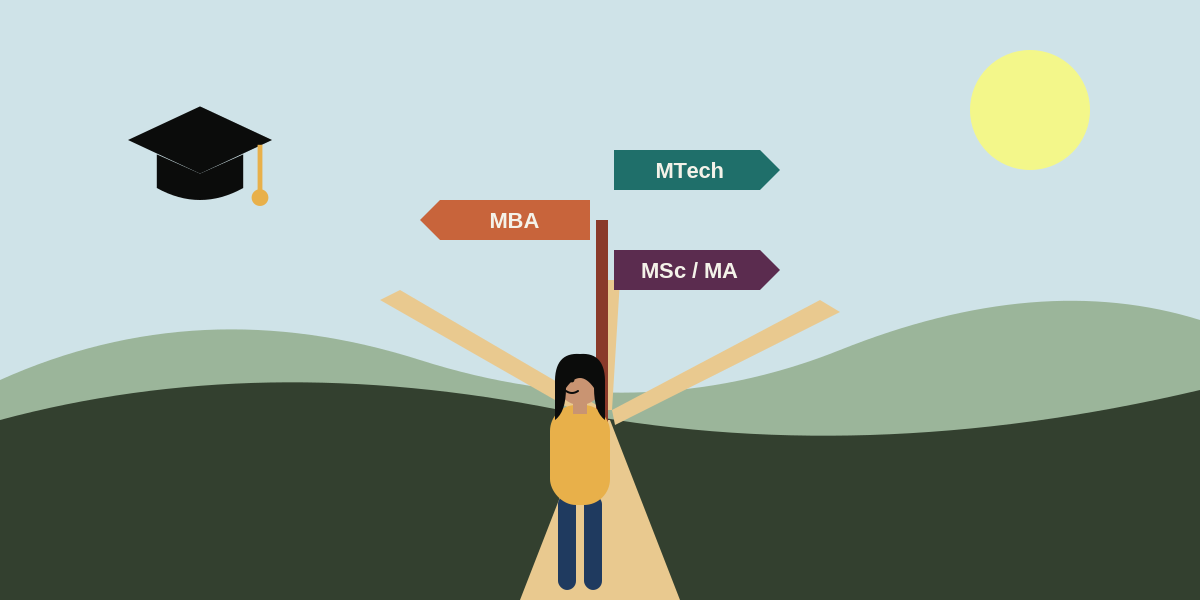
Question one: do you need a master's at all?
A master's degree is worth it when it opens a door you cannot open otherwise, or when it gives you skills you cannot reasonably learn on the job. Examples include university teaching and research, many specialist roles in science and engineering, clinical psychology, some policy and development careers, and fields where employers routinely ask for a postgraduate qualification.
It may not be worth it, at least not yet, if you are choosing it mainly to delay a job search, because friends are doing it, or because you hope it will fix an unclear career direction. In those cases, a year or two of work often clarifies what to study and makes the degree far more useful.
The main options compared
| Degree | What it is for | Typical entrance route in India |
|---|---|---|
| MBA / PGDM | Management, consulting, marketing, finance, operations and leadership roles | CAT, XAT, CMAT, GMAT and institution tests, plus interviews |
| MTech / ME | Deep technical specialisation, R&D, design roles and doctoral research | GATE, or institution tests and sponsored routes |
| MSc | Advanced study in a science, mathematics, statistics or data field; research and teaching | JAM for the IITs and some institutes; CUET-PG; university tests |
| MA | Humanities and social sciences; civil services preparation, teaching, research, policy, media | CUET-PG and university tests |
| MCA | Software development and IT roles, especially for non-engineering graduates | NIMCET for NITs, CUET-PG and state or university tests |
| LLM | Specialisation in law; academia and specialist practice | CLAT PG and university tests |
| MD / MS | Medical specialisation | NEET-PG |
Names can be misleading. A "Master of Data Science" at one university may be a rigorous statistics degree and at another a light collection of tools. Always read the curriculum.
MBA or MTech after engineering?
This is one of the most common dilemmas. A useful way to decide is to picture your work five years from now:
- If you see yourself designing systems, solving technical problems, leading a technical team or doing research, an MTech or a technical master's abroad fits better.
- If you see yourself managing products, clients, budgets or people, or moving into consulting or finance, an MBA fits better, and usually works best after two to four years of experience.
Some people do both over a career: a technical master's early, then an executive MBA later when they move into leadership.
India or abroad?
Studying in India is usually far cheaper and keeps you close to your network and job market. Studying abroad can give access to specialised programmes, research facilities and international experience, but at a much higher cost. Our study abroad guide covers the process, costs and scholarships in detail.
Full-time, part-time or online?
If you are working, an executive, part-time or approved online master's lets you keep earning. The trade-off is time and energy: evenings and weekends become study time for two years. Make sure online programmes are approved by the UGC for that mode; our comparison of online and regular degrees explains how to check.
Counting the full cost
Add tuition, living costs, study materials and, importantly, the salary you will not earn while studying full-time. Then estimate a realistic starting salary after the degree, using official placement reports or NIRF data rather than headline figures. If you need a loan, calculate the monthly repayment and make sure it is manageable.
Choosing the programme
- Check recognition and, for technical and management programmes, approval and accreditation.
- Read the curriculum and electives; make sure they match the skills you want.
- Look at the faculty and their recent work.
- Ask for placement reports with median salaries, or records of where graduates went for PhDs.
- Speak to current students and recent alumni.
Specialist and interdisciplinary master's degrees
Beyond the familiar names, many universities now offer specialised or interdisciplinary master's programmes: public policy, development studies, data science, sustainability, cognitive science, design, public health, finance, supply chain management and more. These can be excellent if they match a clear career goal and are taught by people with real expertise. They can also be thin repackaging of a few courses under a fashionable title. Look at the core modules, the faculty who teach them, the quality of the final project or dissertation and where graduates have gone. If a programme cannot tell you where its graduates work, treat that as a warning.
Working while you decide
If you are unsure, starting work does not close the door on a master's. In many fields it strengthens your application and helps you choose a programme that fits what you have learned about yourself. Use the first year or two of work deliberately: notice which tasks energise you, which skills you lack, and which roles more experienced colleagues hold. Some employers also sponsor further study for staff, which can make a master's far more affordable. Keep in touch with former teachers so that you can still ask for recommendations later.
Signs you are ready for a master's
- You can explain in two sentences why this programme, and why now.
- You know the kinds of roles graduates of the programme go into, and you want one of them.
- You have checked the full cost and have a funding plan.
- You are prepared for the workload, including independent study and a dissertation or project.
If you can tick all four, you are likely to choose well and get real value from the degree.
Funding a master's degree in India
Funding options depend on the programme. Students admitted to MTech and some MSc programmes at many government institutions through GATE may be eligible for a scholarship or assistantship under the rules of the relevant ministry and institution, often linked to teaching or research duties. Many universities offer merit and need-based scholarships, and central and state governments run postgraduate scholarships through the National Scholarship Portal. Education loans are widely available for professional programmes such as MBAs, but compare interest rates and repayment terms carefully. Whatever the source, read the conditions: some scholarships require a minimum grade each semester or full-time enrolment.
The role of your bachelor's degree
Your undergraduate subject shapes which master's programmes are open to you, but less rigidly than many students think. Engineers move into management, economics and data science; humanities graduates move into law, public policy, journalism and design; science graduates move into business, policy and education. What matters is meeting the stated eligibility conditions and being able to show, through projects, work or a strong statement of purpose, why you are making the switch and how you have prepared for it. If you are changing fields, a bridging course or certification before you apply can make your application much stronger.
A simple decision exercise
Write down three possible paths for the next two years, for example "MTech in India", "MBA after two years of work" and "job now, part-time course". For each, note the cost, the likely job at the end and how excited you feel about the daily work. The right answer is often clearer on paper than in your head.
When you are ready to prepare, our guide to entrance exams in India lists who conducts each exam, and the free Smart Study Planner helps you build a daily routine around work or college.
Sources
Facts, figures and quoted rules in this article come from the sources below. The wording of the article is our own.
- Common Admission Test (CAT), Indian Institutes of Management
- National Testing Agency - CUET-PG and other examinations, NTA, Ministry of Education
- NIMCET, National Institutes of Technology
- National Board of Examinations in Medical Sciences - NEET-PG, NBEMS
- National Institutional Ranking Framework - institution data, Ministry of Education
Frequently asked questions
Should I do a master's immediately after graduation or work first?
If your field requires a master's for entry, such as many research, teaching and specialist roles, studying straight away makes sense. For management and many professional paths, a few years of work often makes the degree more valuable and helps admission.
Is an MBA better than an MTech after engineering?
Neither is better in general. An MTech deepens technical expertise for specialist and research roles; an MBA prepares you for management and business roles. Choose based on the work you want to do in five years.
Which exam do I need for a master's in India?
Typically CAT and other management tests for MBA, GATE for MTech, JAM for MSc at the IITs and some institutes, and CUET-PG for many central and participating universities. Some institutions use their own tests.
Is a one-year master's degree valid?
In India, the UGC credit framework allows a one-year master's after a four-year bachelor's degree. Abroad, one-year taught master's degrees are common in the UK and parts of Europe. Check how employers or further study in your target country view the specific degree.